AI Agents Are Only as Smart as Their Context

The AI Agent Illusion: Why More Automation Does Not Solve Everything
AI agents are quickly becoming the next frontier of digital transformation. They promise not only to analyze information, but also to act on it, triggering workflows, making suggestions, composing content, or performing tasks on behalf of employees. It is easy to assume these agents have a form of autonomous intelligence.
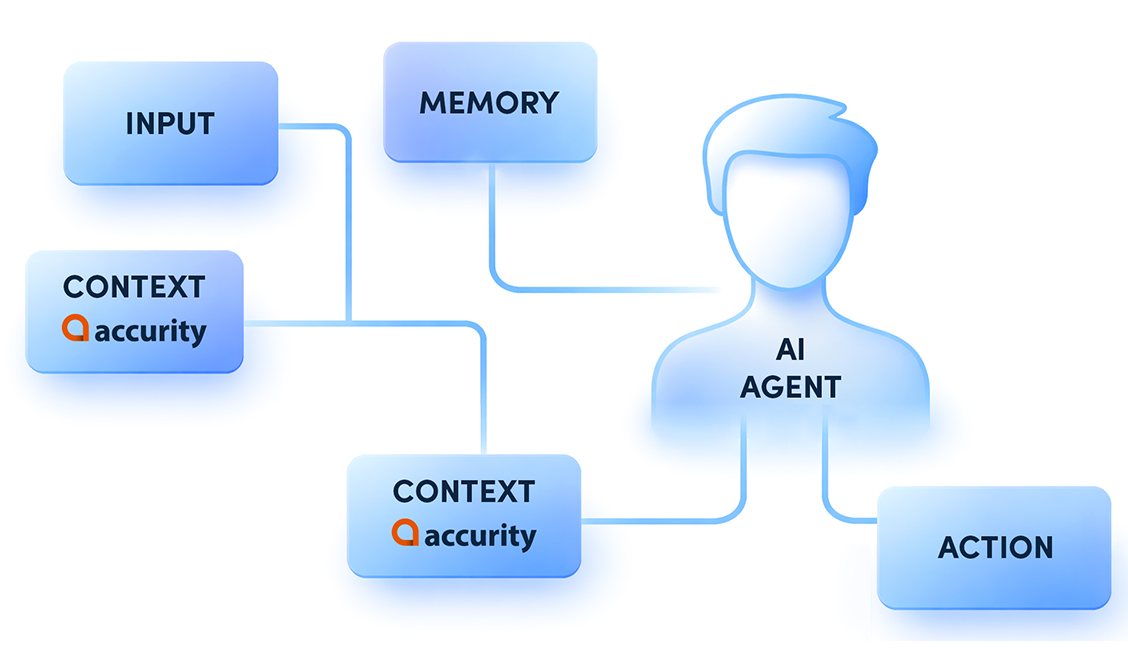
Even the most advanced agent is only as capable as the data and context it receives. Without clear context, an agent resembles a fast, diligent, inexperienced intern. It executes with confidence, yet without true understanding. It follows patterns rather than intent, and when the data contains subtle ambiguity, it fills the gaps with assumptions, often the wrong ones.
Many organizations discover this as soon as their first agent based processes go live. Outputs vary, actions misfire, and decisions do not fully align with business expectations. The root cause is rarely the agent itself. It is the missing context the agent needs to reason reliably.
Drowning in Data, Starving for Meaning
Modern organizations generate enormous amounts of data. Yet this abundance creates a paradox: more data can lead to more confusion for agents, not more clarity.
Consider a simple field like “customer status.” In different systems and teams, it may represent onboarding progress, contract activity, engagement level, or something else entirely. Humans can ask questions, compare notes, and resolve discrepancies. Agents cannot. They treat values literally. They do not question whether identical labels carry different meanings, or whether different labels describe the same underlying concept.
Agents act based on what they can “see,” not on what the data is meant to represent. When context is missing, their behavior becomes unpredictable. A workflow may trigger incorrectly, an escalation may target the wrong issue, or generated content may be grounded in misinterpreted fields.
The problem is not lack of data. It is lack of clarity about what the data means.
What Context Really Means for AI Agents
Context is the layer of meaning that allows agents not just to process information, but to interpret it correctly. It includes several interconnected dimensions.
Business context: shared definitions, business terms, and a unified understanding of key concepts.
Structural context: metadata that explains relationships, hierarchies, and dependencies within and across systems.
Operational context: lineage describing how data arrived in its current form.
Quality context: rules that define which values are valid, why they matter, and how exceptions should be treated.
Ownership: clarity about who governs the meaning and correctness of each piece of data.
Without this context, agents improvise. They rely on patterns rather than business logic, and correlations rather than meaning. A small difference in definition becomes a major misalignment in agent behavior.
Agents do not hallucinate in the same way that large language models do, yet they still misinterpret. Misinterpretation becomes far more dangerous when an agent is empowered to act, automate tasks, or make operational decisions.
Building Agents You Can Trust: Context as the Foundation
Trustworthy agents require trustworthy context. Organizations that want agents to behave predictably and deliver value need a solid foundation of shared meaning.
This starts with a unified business language so every department, system, and model interprets terms consistently. It continues with high quality metadata and mapping that reveal relationships and help agents understand how elements fit together. Lineage adds transparency into the origins of data, improving explainability when agents make decisions or trigger workflows. Contextual data quality rules help agents avoid acting on incomplete or invalid inputs. Continuous governance ensures that as the business evolves, the context agents rely on evolves with it.
When this structure is in place, agents become more reliable and more powerful. They make decisions that align with business intentions, not just statistical signals. Their actions reflect real world logic. Their recommendations are explainable. Their performance can be trusted.
Accurity plays a critical role in creating this environment. By capturing business meaning, documenting definitions, mapping metadata, enforcing data rules, and providing organizational visibility, Accurity ensures that the data feeding AI agents is not only correct, but also meaningful. This context rich foundation improves agent reasoning and helps agents act responsibly and effectively.
The Future Belongs to Context Rich Agents
As organizations adopt AI agents to automate tasks, navigate workflows, and support operations, context becomes even more essential. The next generation of agent based automation will not be defined by how many actions an agent can perform, but by how accurately and intelligently it performs them.
Agents that operate on context rich data will outperform those that operate on isolated facts. They will be more transparent, trustworthy, and aligned with business processes. They will reduce operational risk rather than amplify it. They will unlock value that goes far beyond simple automation.
AI agents are not inherently intelligent. They gain intelligence through context, through understanding the meaning and purpose behind the data they consume. Organizations that invest in contextual clarity today will build agents that make better decisions tomorrow.
Want to see Accurity for yourself?
Get a free personalized 1-on-1 demo.


